.jpg)


Who Really Invented Money? (And Why the System Still Runs on Their Rules)
If you caught my recent short on the history of wealth, you saw the comments blowing up. It turns out, a lot of you: the welders, the barbers, the HVAC techs, and the shop owners: are tired of feeling like the game is rigged. You’re working twelve-hour shifts, keeping the world turning, but the numbers in your bank account feel like they’re being controlled by a ghost in a machine.
The question I kept getting was: Who actually invented this stuff?
Was it some ancient king? A group of greedy bankers in a smoke-filled room? Or did money just appear out of thin air?
The answer isn't just a history lesson; it’s the key to understanding why you feel stuck and how you can finally break the cycle. Money wasn't "invented" as a gadget or a product. It was invented as a social contract. And if you don't understand the rules of that contract, you’re not a player in the game: you’re just the prize.
The Thread Through Hammurabi: The Legal Skeleton
To understand money, we have to look past the dollar bills in your wallet and look at what I call the "Thread Through Hammurabi."
Around 3000 BC in ancient Mesopotamia, people weren't walking around with coins. They were using clay tablets. If a farmer brought his grain to a temple (the original bank), the priest would give him a clay tablet representing that grain. That tablet was a contract. It was an order.
Then came Hammurabi. You might remember him from history class as the guy with the "eye for an eye" laws. But Hammurabi did something much more profound for your wallet: he created the Legal Skeleton. He established a system of order where a contract actually meant something.
Money isn't just metal or paper; it’s a representation of Order. Without a legal framework: a skeleton to hold up the flesh of commerce: money is worthless. This is the moral evolution of financial order: it moved from Hammurabi (civil order) to Moses (obedience to a higher law) to Christ (a change of the heart).
When you understand that money is a tool of the Covenant, your perspective shifts. You stop seeing it as something to be hoarded or feared and start seeing it as a test of your stewardship. As it says in Luke 16:11, "So if you have not been trustworthy in handling worldly wealth, who will trust you with true riches?"
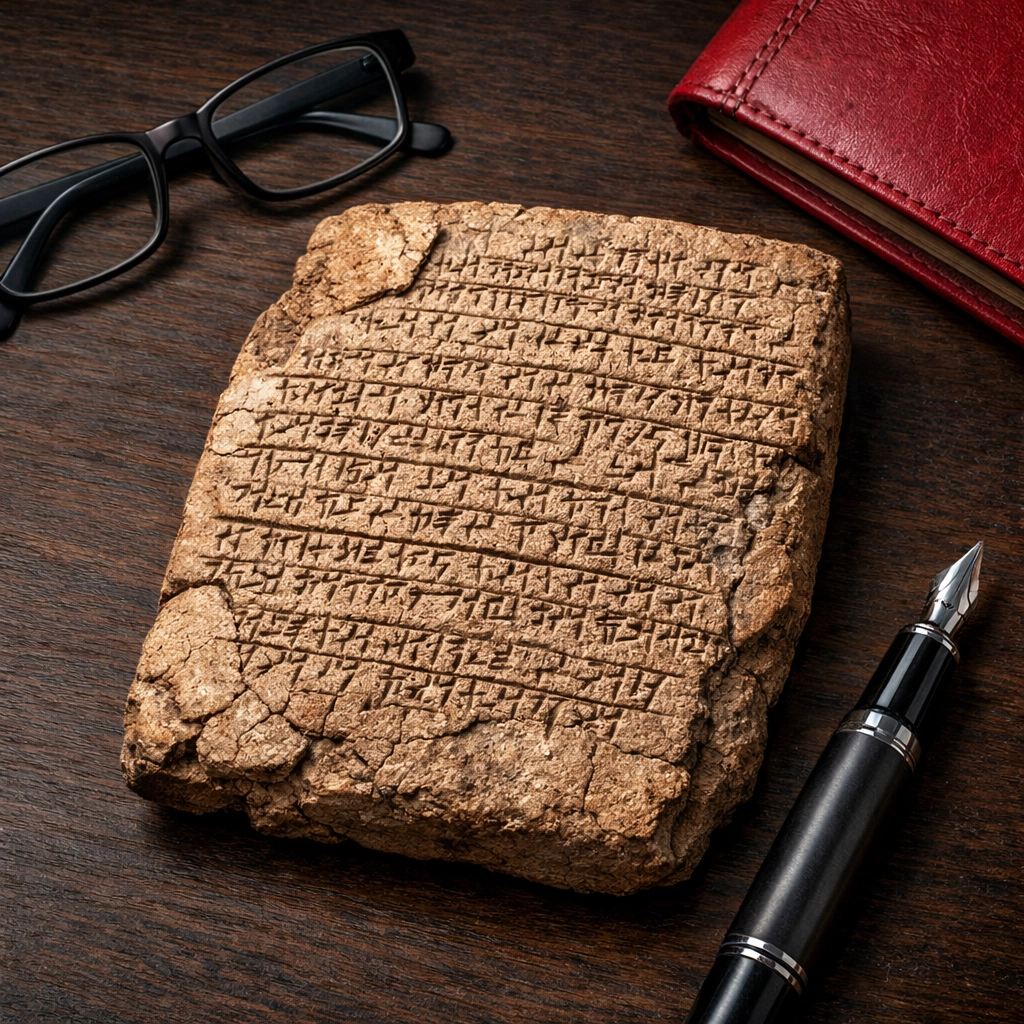
From Shekels to Digital Cycles: The Form Changes, the Rules Don't
History tells us that the first official coins showed up in Lydia (modern-day Turkey) around the 7th century BC. The king decided to stamp his face on a piece of electrum (gold and silver) and declare it "Legal Tender."
This was a massive shift. Suddenly, the ruler controlled the system. They used these coins to pay soldiers and, more importantly, to collect taxes. This established a rule that still exists today: The entity that provides the order also sets the rules of the currency.
Fast forward to 2026. We aren't trading gold coins or clay tablets. We’re trading digital cycles: blips on a screen. But here’s the kicker: the rules of stewardship, order, and growth haven't changed in five thousand years.
The system still runs on the same ancient principles. If you operate outside of order, you lose. If you violate the Law of Stewardship by drowning in consumer debt, you are effectively breaking the social contract that leads to freedom. Debt isn't just a financial burden; it’s a violation of your role as a Warrior-Steward.
The Myth-Buster: Why the "Paper Tiger" is Failing You
Many of you have been told to follow the "Buy Term and Invest the Difference" (BTID) model. It sounds simple, right? Get cheap insurance, throw the rest in a mutual fund, and hope for the best.
But here’s the truth: BTID is a tactical failure. It’s what I call a "$1.6M Paper Tiger." It looks good on a spreadsheet until the "Order" of the market breaks down.
When the S&P 500 climbed over 400% from 2012 to 2026, the BTID crowd felt like geniuses. But they forgot about the crashes of 2001 and 2008. If you lose 40% of your capital in a downturn, you don't just need 40% to get back to even: you need 67%.
In our framework at My Business Is Your Business / All Into Life, we don't play that game. We use the "Best of Both Worlds" strategy: pairing the "Sword" (Growth) with the "Shield" (Protection).
The Sword: You participate in the large gains of the S&P 500.
The Shield: You have an EIUL with a 0% floor. When the market crashes, your principal stays exactly where it is.
Preserving capital during the bad years is what allows you to capture the massive upside of the good years. This isn't just "saving"; this is Asset Armor.

The Math of the Flywheel: Your Money Doubles Every 2.5 Years
Let’s talk about "Wealth Capacity." If you aren't using the Rule of 72, you’re flying blind.
The Rule of 72 is a simple way to see how fast your money doubles. You take 72 and divide it by your annual return. Most people are happy with 7% or 8%. But when we look at an annual average growth of 28.9%: which is achievable when you eliminate the losses: the math changes your life.
72 ÷ 28.9 ≈ 2.5 years.
Think about that. Your money has the potential to double four times in a decade. That is how you build a Flywheel. Once that momentum starts, it becomes very hard to stop. But you can't build a flywheel on a broken foundation. You need the order of the "Thread Through Hammurabi" and the protection of a "Moat."
Reclaim the Social Contract
The system was designed by rulers to keep society in order. For most people, that means being a cog in the machine. But for the Warrior-Steward, the system is a toolkit.
You don’t have to sacrifice growth to get protection. You don’t have to follow dated, "blue-collar" advice that keeps you working until you’re 80. You can build your own Moat: a layer of safety that protects your family: and then launch your Flywheel.
Whether you’re in Texas, Michigan, California, Georgia, or Idaho, the rules of the game are the same. I’m licensed in all these states to help you navigate these ancient rules with modern tools. We’re not just talking about "Financial Peace of Mind"; we’re talking about financial sovereignty.

Your Next Step: Build Your Moat
Stop settling for the "Paper Tiger" strategies that leave you vulnerable to the next market cycle. The ancients knew that wealth requires both a sword and a shield. It’s time you had both.
If you’re ready to see how the DNA of the Doorpost and a Relationship-Not-Religion approach to finance can change your legacy, let’s talk.

CTA: Reclaim Your Legacy
Are you ready to move from being a "Fleet Mechanic" to building a "Financial Fortress"? Don't wait for the next market crash to realize your shield is made of paper.
[Click here to book a strategy call with Reuben Lowing] and let's start building your Moat today.
Want to dive deeper into why the old ways are failing? Check out our breakdown on The Bill vs. Ted Blueprint or learn the truth about IUL Secrets.
Reuben Lowing Vice President/Agent My Business Is Your Business / All Into Life Serving Texas, Michigan, California, Georgia, and Idaho.


Comments