.jpg)


Living Trust Vs Will: The 2026 Guide to Protecting Your Digital Life, Not Just Your House
Here's something most estate planning attorneys won't tell you until you're already sitting in their office: your Bitcoin wallet, your Instagram account with 50,000 followers, and your digital photography business are worth more than your furniture: but your grandma's will template doesn't cover any of it.
Welcome to estate planning in 2026, where your "assets" include things that didn't exist when most legal documents were written. If you're still thinking a simple will covers everything you need, you're about to discover why that strategy is about as effective as bringing a knife to a drone fight.
Let's break down the real difference between a Living Trust and a Will: and why one of them is actually built to protect the life you're living right now, not the one your grandparents had in 1985.
The Basics: What's Actually on the Table Here?
A Will is a legal document that kicks in after you die. It tells the court who gets your stuff, who should raise your kids if you have minors, and how to divide everything up. Sounds solid, right? Here's the catch: it has to go through probate: a court-supervised process that's public, slow, and expensive.
A Living Trust, on the other hand, is effective the moment you create and fund it. You transfer your assets into the trust, you control them while you're alive, and when you pass away (or become incapacitated), a successor trustee you've named steps in and handles everything. No court. No delays. No public record of what you owned or who got what.
Think of a Will like sending your family's financial future through airport security: it's going to get searched, delayed, and everyone's going to see what's in your bags. A Living Trust is more like TSA PreCheck: you move through quickly, privately, and without hassle.

The 2026 Reality: Your Digital Life Is Your Real Life
Here's where estate planning gets interesting in 2026. Your "estate" isn't just a house and a bank account anymore.
Let's say you've built a dropshipping business that runs on Shopify, you've got a portfolio of NFTs and crypto in three different wallets, you own domain names worth $20K, your spouse manages a TikTok account that brings in $5K/month in brand deals, and you've got 10 years of family photos stored in the cloud.
Now ask yourself: does your current will even mention those things?
Most wills written even five years ago don't. And here's the scary part: if your heirs don't know those assets exist, or they can't access them because they're locked behind two-factor authentication and a password manager only you know, those assets disappear. Forever.
A properly structured Living Trust in 2026 doesn't just list your house and car. It includes:
Cryptocurrency wallets (with clear instructions on access)
Online business assets (domains, e-commerce stores, digital products)
Social media accounts with monetization value
Cloud storage and digital files (photos, videos, intellectual property)
Subscription-based income streams (Patreon, OnlyFans, Substack, YouTube)
Digital intellectual property (eBooks, courses, software, music rights)
The trust names a Digital Asset Trustee: someone tech-savvy enough to actually access and manage these accounts, not just inherit them in theory.
Why Probate Is a Nightmare (And Getting Worse)
Let's talk about probate, because this is where a Will falls apart and a Living Trust shines.
Probate is the court process of "proving" your will is valid, appointing an executor, paying off debts, and distributing assets. It typically takes 12-18 months and costs 4-8% of your estate's value in legal and statutory fees. In some states, that's $40,000 on a $500,000 estate.
But here's the 2026 problem: probate was designed for a world where estates were houses, cars, and bank accounts. Judges and probate courts have no idea how to handle crypto wallets, NFTs, or cloud-based businesses.
I've seen cases where families lost access to six-figure crypto portfolios because the probate court didn't understand how hardware wallets work. I've seen TikTok accounts with 200K followers get permanently banned because the platform's terms of service don't allow account "transfers": and probate took so long the account went dormant and got nuked.
With a Living Trust, there is no probate. Your successor trustee takes over immediately, accesses your digital assets using the instructions you left, and keeps everything running. No court. No delays. No risk of losing access.

Privacy: Do You Really Want Your Business on Blast?
Here's something people don't think about until it's too late: probate is public record.
When your will goes through probate, anyone: anyone: can look up what you owned, how much it was worth, who inherited it, and whether there were family disputes. Nosy neighbors. Scammers. Estranged relatives looking for a cut.
A Living Trust is completely private. It's a contract between you and your beneficiaries. No court filings. No public record. Your financial life stays your family's business.
If you're a business owner, this is especially critical. You don't want competitors, former employees, or random internet sleuths knowing the details of your estate. And you definitely don't want your kids' inheritance becoming public knowledge: because that's how they become targets for scams, lawsuits, and "long-lost friends" with their hands out.
Incapacity: The Scenario No One Wants to Talk About
Here's a scenario most people ignore when they're drafting estate plans: What happens if you don't die, but you can't manage your own affairs anymore?
Stroke. Dementia. Car accident. Serious illness.
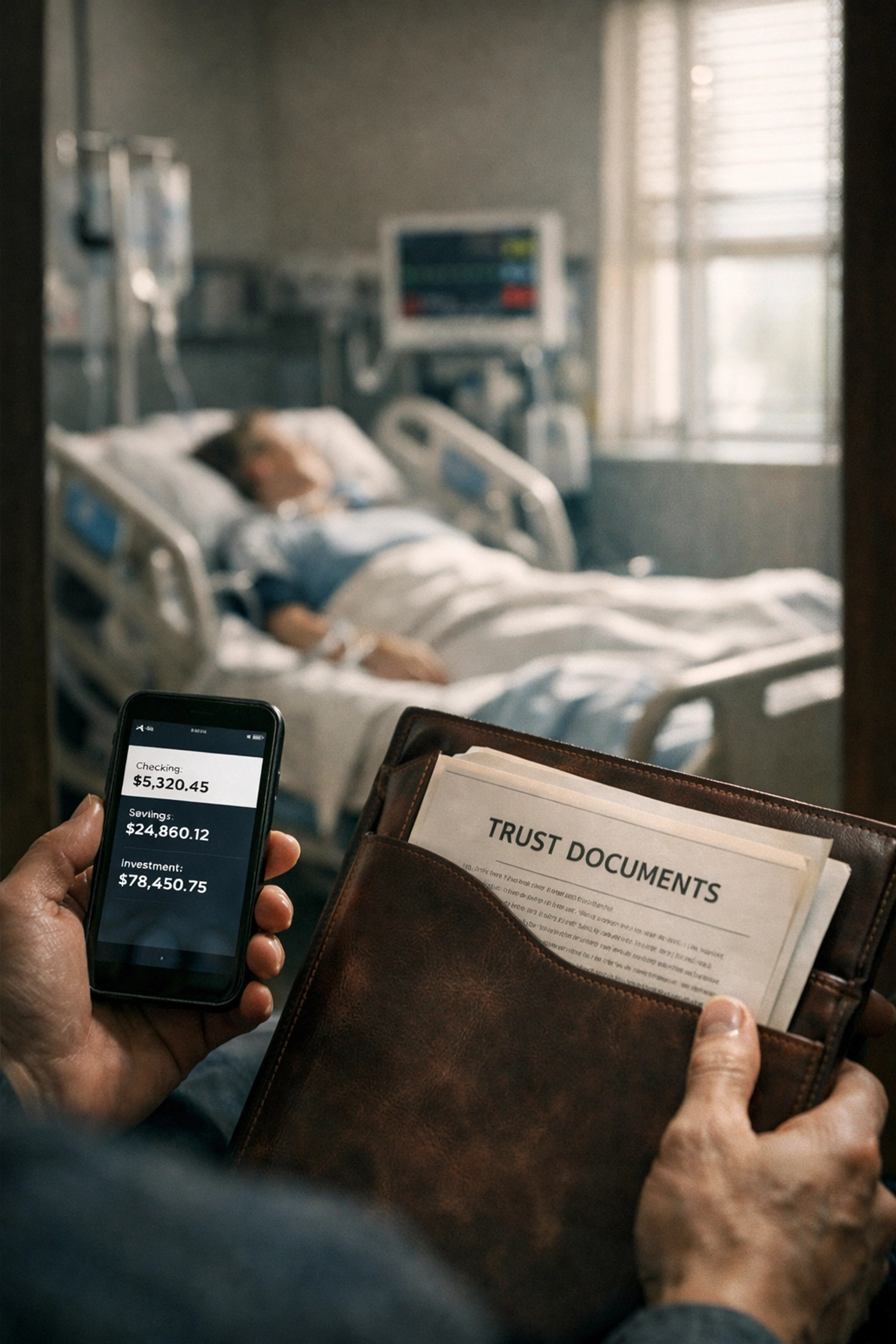
If all you have is a Will, it does nothing to help you while you're alive. Your family would have to go to court, petition for conservatorship, prove you're incapacitated, and get legal authority to manage your assets. That process can take months and cost tens of thousands of dollars: and it's public, humiliating, and emotionally brutal.
With a Living Trust, your successor trustee steps in immediately: no court, no conservatorship, no delays. They can pay your bills, manage your business, access your accounts, and keep everything running while you recover (or if you never do).
This is where the military mindset comes in: you plan for worst-case scenarios, not best-case ones. A Living Trust is your contingency plan. It's your insurance policy against chaos. It's how you protect your family when you can't protect them yourself.

Generational Wealth: Building the Foundation Your Kids Will Stand On
Let's talk about why this matters long-term.
A Will distributes your assets after you die: and that's it. It's a one-time event. There's no structure, no strategy, no protection for your heirs after they inherit.
A Living Trust, especially a well-designed one, can be structured to protect generational wealth. You can set conditions on distributions (kids get X amount at 25, more at 30, full access at 35), protect assets from creditors and lawsuits, and ensure your wealth doesn't get blown in a single bad decision.
You can also build in provisions that teach financial discipline. Maybe your kids get income from the trust, but they don't get full control until they demonstrate financial responsibility. Maybe the trust funds their education, their first business, or a down payment on a house: but they can't just cash out and buy a Lambo.
This isn't about controlling your kids from beyond the grave. It's about setting them up to win, not setting them up to fail. And in 2026, when financial temptations are one TikTok ad away and crypto scams are everywhere, that structure matters.
When You Need Both (Yes, Both)
Here's the reality: most families need both a Living Trust and a Will.
A Living Trust can't do everything. It can't name guardians for your minor children: that has to be done in a Will. And if you forget to transfer an asset into the trust (it happens), you'll want a "pour-over will" that catches those stragglers and funnels them into the trust after death.
But the Living Trust should be the centerpiece of your estate plan. It's the fortress. The Will is just the backup parachute.
The Bottom Line: Protect What You've Built
If you've spent years building wealth, growing a business, and creating a life that supports your family, don't let a lazy estate plan destroy it all in probate court.
A Living Trust isn't just for rich people with vacation homes and stock portfolios. It's for anyone who has digital assets, online income, crypto, or a business they want to protect. It's for anyone who wants their family to avoid months of court hearings, legal fees, and public scrutiny.
And in 2026, that's pretty much everyone.
This is about more than paperwork. It's about securing your legacy. It's about making sure the wealth you've built actually reaches the people you love: quickly, privately, and without drama.
Your mission, if you choose to accept it: get your estate plan into the 21st century. Because your digital life deserves the same protection as your physical one.
Want to talk through your estate strategy and make sure your digital assets are actually protected? Let's connect: because protecting generational wealth isn't just smart. It's strategic.


Comments